Daniel Barenboim Conductor
West-Eastern Divan Orchestra
Program
Ludwig van Beethoven
Overture Leonore No. 3 Op. 72b
Richard Wagner
Prelude and Liebestod
from Tristan und Isolde
Franz Schubert
Symphony No. 8 in C major D 944 "Great"
Ludwig van Beethoven (1770–1827)
Overture Leonore No. 3 Op. 72b (1806)
Adagio – Allegro
Richard Wagner (1813–1883)
Prelude and Liebestod
from Tristan und Isolde (1857–9)
Intermission
Franz Schubert (1797–1828)
Symphony No. 8 in C major D 944 "Great" (1825–8)
I. Andante – Allegro ma non troppo
II. Andante con moto
III. Scherzo. Allegro vivace
IV. Allegro vivace
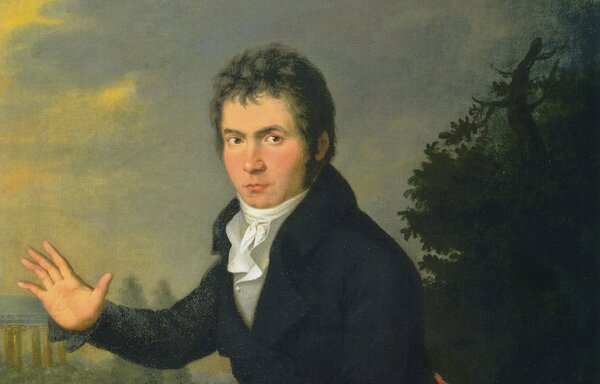
Ludwig van Beethoven, portrait by Joseph Willibrord Mähler (detail, c. 1804) (Wien Museum)
Notes on the Program
Daniel Barenboim and the West-Eastern Divan Orchestra open the first edition of the West-Eastern Divan Festival at the Philharmonie Berlin with two of music history’s best-known overtures, followed by Franz Schubert’s magnificent C-major Symphony.
Notes on the Program
Ludwig van Beethoven
Overture Leonore No. 3 Op. 72b
Ludwig van Beethoven left behind only one opera. Yet like the unique music dramas of Debussy and Bartók, Fidelio provides such a milestone that it is possible to ignore the lack of companions. Beethoven had nonetheless planned for other stage works. Vestas Feuer, the project he had envisaged with Emanuel Schikaneder (librettist of Die Zauberflöte) was seemingly abandoned in favor of the “Eroica” Symphony. But there was also a more pertinent libretto on hand, based on the French revolutionary Jean Nicolas Bouilly’s play Léonore, ou L’amour conjugal.
The resulting Fidelio tells the story of Bouilly’s title character who, disguised as a boy (Fidelio), rescues her husband from prison. Given the turbulent times in which the opera was written, some have seen Florestan’s incarceration as an allegory of Beethoven’s deafness, while others have found in Leonore’s selfless resolve something of the progressive spirit of the age: “I will loose your chains whoever you are, unhappy man, by God I will save you and set you free.”
When the opera was first performed in Vienna in 1805, four days after Napoleon’s troops had entered the city, it was played with a different overture, now known as Leonore No. 2 Op. 72a—the earlier prelude, or Leonore No. 1 Op. 138, having already been abandoned. But when Beethoven came to revise the score for performances in March 1806, he composed an entirely new overture: Leonore No. 3. The grandest and most symphonic of them all, it depicts Florestan’s imprisonment and, in its climax, his liberation.
The composition was, however, a victim of its own success, proving both too dramatic as a curtain-raiser and too comprehensive an adumbration of the opera. Consequently, Beethoven was prompted to write the now-established Fidelio Overture. Yet Leonore No. 3 has been too thrilling for musicians to resist, with Gustav Mahler, among many others, famously inserting the music between the two scenes of Act II, thereby providing a prelude of sorts to the drama’s denouement—as well as turning the spotlight from the stage to the orchestra pit. The score has, likewise, enjoyed a suitably rich life in the concert hall.
Richard Wagner
Prelude and Liebestod from Tristan und Isolde
Halfway through composing Der Ring des Nibelungen, Richard Wagner broke off work on the cycle to write Tristan und Isolde. The reasons are not entirely clear, though many have suggested a combination of practical, philosophical, and emotional necessity. Unlike the enormous Ring, Tristan was intended to be a more realistic, readily performable work, to be composed quickly for comparatively modest forces. Clearly, the hope was that it would be disseminated widely and bring in much-needed income. While, indeed, small in the number in its cast, the resulting work was anything but ordinary and provided two of the most demanding roles in the operatic repertoire.
The manner in which approachability gave way to ambition was, doubtless, due to the opera’s philosophical import. At the time, Wagner was enthralled by the writings of Arthur Schopenhauer, including the philosopher’s idea that redemption is attainable only through the mystical oblivion of death. To communicate such thoughts through music, aligned to the narrative of Gottfried von Strassburg’s 13th-century courtly romance Tristan, was no easy task, to say nothing of reflecting the emotional, autobiographical import of the work, namely Wagner’s love for his patron Otto Wesendonck’s wife Mathilde.
The resulting opera is without equal and has drawn figures as diverse as Berg, Debussy, Mahler, Messiaen, Schoenberg, Strauss, and Szymanowski into its orbit. Listening to the opening and final sections of the score, it is easy to hear why. The Prelude deftly conjures the vastness of the psychodrama that will unfold through passionate, ever-mounting sequences. These chains of dissonance are triggered by the first homophonic sound we hear, what has become known as the “Tristan chord.” Essentially a chromatically altered, functionally ambiguous harmony, its augmented intervals and delayed resolution similarly suspend conventional expectations of tonality. Indeed, such is the scope of that deferral, that resolution only really comes at the very end of the opera.
In concert, this final passage has become known as the Liebestod (love death), reflecting words from Wagner’s own libretto, although the composer originally used that title for the Prelude and called the Finale Isoldes Verklärung (transfiguration). It recalls music first dictated to her by Tristan in the opera’s second act, when he tells Isolde that they will die “unseparated, ever one, without end, without waking, without anxiety, namelessly encircled in love.”
Franz Schubert
Symphony No. 8 in C major “Great” D 944
In 1824, a rather ill and fatigued Franz Schubert expressed a desire to mount a major public concert in Vienna featuring several new works. Hoping to emulate and, indeed, compete with Beethoven, he intended “to pave the way towards a grand symphony.” Unfortunately, given the composer’s continuing poor health, the project would take much longer to come to fruition—indeed, he would never hear the Symphony performed—yet in 1825 Schubert did feel fit enough to leave Vienna and travel to the Salzkammergut with his baritone friend Johann Michael Vogl.
It was here, among the region’s majestic scenery, that Schubert finally began work on a large orchestral score. For a while, it was presumed this must have been the lost “Gmunden–Gastein” Symphony D 844. But when the paper used for the supposedly later “Great” C-major Symphony was analyzed—a work previously thought to have been written exclusively in 1828—it became pretty clear that it and the “Gmunden–Gastein” work were one and the same thing.
Throughout the score, Schubert appears to be communing with nature, much as Mahler would do within the same landscape 60 years later. Similarly, the scale of the work, what Schumann described as its “heavenly length,” marked a move away from Classical proportions. It all begins in a mood of rapt Natureinsamkeit, with a horn call, as if heard from afar. Chorale-like tenderness provides validation, though there is also a melancholy streak, further delaying the rush of the Allegro ma non troppo. Even the strident, heroic tones of the full orchestra do not launch the sonata structure proper, for there will be no “greatness” at the expense of personality or the acknowledgement of doubts past.
If, at times, the conclusion to the Allegro can feel a little too confirmatory, there is no sense that the drama is over by the time we reach the second movement. It is full of the subjective Schubert of the songs and chamber music. Yet there is a crucial difference. Where, for instance, in Winterreise or in passages of the string quartets, an eerie, spectral quality dominates, here, in Schubert’s last (completed) symphony—there would be sketches for another in 1828—there is rarefied poise and, at times, fortissimo purpose.
A more pungent air is suggested by the bucolic, dancing scherzo, where the presence of A-flat major harks back to the first movement. There is also a formal kinship in the embrace of sonata form, with something of its developmental purpose, as well as the repetitive rhythmic elements that will return in the finale. Here, certainly, Schubert offers a wealth of material, answering both the dauntlessness of Beethoven’s Seventh Symphony and the gallantry of his own first movement.
—Gavin Plumley
Gavin Plumley is a cultural historian whose writings appear in newspapers, magazines, and opera and concert programs worldwide. His first book, A Home for All Seasons, was published in 2022; his second, The Gay Apocalypse (dt. Traum und Begehren) will appear in both English and German next year.
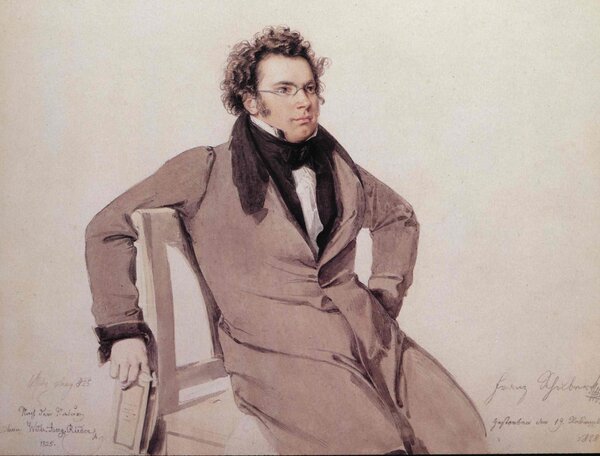
Franz Schubert, watercolor by Wilhelm August Rieder (1825) (Wien Museum)
Zum Programm
Daniel Barenboim und das West-Eastern Divan Orchestra eröffnen in der Philharmonie Berlin die erste Ausgabe des West-Eastern Divan Festivals mit zwei der berühmtesten Ouvertüren der Musikgeschichte und Franz Schuberts großer C-Dur-Symphonie.
Zum Programm
Ludwig van Beethoven
Ouvertüre Leonore Nr. 3 op. 72b
Wer unvoreingenommen Ludwig van Beethovens Leonore-Ouvertüre Nr. 3 hört, dürfte kaum ahnen, welch ein langwieriger Entstehungsprozess sich hinter diesem Werk verbirgt. Am Anfang stand der Entschluss des vor allem durch Klavierwerke und seine ersten Symphonien bekannt gewordenen Komponisten, endlich auch mit einer großen Oper zu reüssieren – mit einer „Rettungs- und Befreiungsoper“, wie sie in Frankreich vor allem Luigi Cherubini zu großem Erfolg geführt hatte. Ein Auftrag des Theaters an der Wien gab Beethoven die ersehnte Gelegenheit, ein Bühnenwerk zu schreiben (als Libretto-Vorlage diente die Oper Léonore, ou L’amour conjugal des heute vergessenen Pierre Gaveaux), doch der theaterunerfahrene Komponist musste bitteres Lehrgeld bezahlen. Die Uraufführung von Fidelio 1805 fand nur wenig Resonanz, einschließlich der zu dieser Gelegenheit gespielten Ouvertüre, heute bekannt als Leonore Nr. 2. Schon 1806 folgte deshalb eine überarbeite Neufassung, bei der erstmals die Leonore-Ouvertüre Nr. 3 erklang.
Doch Beethoven blieb unzufrieden mit dem Ergebnis, weitere massive Änderungen und Straffungen in Text und Musik folgten, die sich schließlich bis 1814 hinzogen. Erst dann kam die heute geläufige Fassung des Fidelio zur Erstaufführung, diesmal mit der vierten Version der Ouvertüre, wie sie seitdem üblicherweise die Aufführung einleitet. Es war dem Komponisten wohl klar geworden, dass Leonore Nr. 3 als Einstieg allzu gewichtig wirkte und das ganze Drama der Oper bereits vorwegnahm. Zu Beginn der Adagio-Einleitung erklingt ein mit Leonore assoziiertes Motiv, die ihr Leben für die Befreiung des eingekerkerten Florestan wagen will; darauf folgt erstmals im Pianissimo das Hauptthema, doch die Musik schwankt zwischen Hoffen und Bangen, bis ein zweimaliges Trompetensignal die Ankunft des Ministers ankündigt. Seine Begnadigung des gefangenen Florestan mündet in den von den Streichern angestimmten Schlussjubel im strahlenden C-Dur.
Wie Beethovens Ouvertüren zu Coriolan oder Egmont hat sich die Leonore-Ouvertüre Nr. 3 als eigenständiges Werk einen festen Platz im Konzertrepertoire erobert. Um die Komposition auch im Kontext der Oper zu erleben, kam Gustav Mahler als erster auf den Gedanken, sie als instrumentales Zwischenspiel in den zweiten Akt von Fidelio einzufügen – eine Idee, der viele Andere später gefolgt sind.
Richard Wagner
Vorspiel und Liebestod aus Tristan und Isolde
Nur in den frühen Schaffensjahren stellte Richard Wagner seinen Opern Ouvertüren voran. Seit der Komposition von Lohengrin verwendete er den deutschen Begriff Vorspiel – so auch bei Tristan und Isolde, jener „Handlung in drei Aufzügen“, die 1865 am Hoftheater in München ihre Uraufführung erlebte. Mit diesem Vorspiel stimmt Wagner nicht nur auf das Liebesdrama ein, das den dunklen Zauber von Nacht, Traum und Vergessen der taghellen Realität gegenüberstellt. Er öffnete auch mit einem Schlag die Tür zu völlig neuen harmonischen Welten, zu nie zuvor gehörten Klängen, von denen Komponist:innen-Generationen nach Wagner noch lange zehren sollten.
Insofern ist es alles andere als übertrieben, von diesem gut zehnminütigen Stück als einem der einflussreichsten Werke der gesamten Musikgeschichte zu sprechen. Der sehnsuchtsvolle einleitende Sextsprung, nur von den Violoncelli angestimmt, leitet hin zum vielanalysierten „Tristan-Akkord“ (f–h–dis–gis), einer „unerhörten“ Verbindung von Tritonus, großer Terz und Quart, mit der Wagner die bewährten Gesetze der Tonalität aus den Angeln hob und der Dissonanz eine völlig neue, dominierende Rolle zukommen ließ, da ihr die Auflösung zur Konsonanz verweigert wird.
So bleibt die Musik in einem permanenten Schwebezustand der Unruhe, sie kennt keine klaren Einschnitte und lässt die Motive nahtlos ineinander übergehen, um sich in stetigen Wellenbewegungen zu einem gewaltigen Höhepunkt zu steigern – komprimiertes Abbild jener extremen Verquickung von Liebe, Nacht und Tod, welche die Oper in größtmöglichen Dimensionen ausspielt. Mit einer unvergleichlichen Fülle von Klangfarben schafft Wagner hier zugleich ein Meisterwerk rein musikalischer Imagination. In der Konzertfassung geht das Vorspiel direkt über in das Ende des Werkes, den als „Liebestod“ bekannten Schlussgesang der Isolde. Mit einem ätherischen H-Dur-Akkord löst er schließlich die zu Beginn des Werks gestellte musikalische Frage auf.
Franz Schubert
Symphonie Nr. 8 C-Dur D 944 „Große“
Franz Schuberts Symphonie Nr. 8 – zur Unterscheidung von seiner Sechsten in der gleichen Tonart C-Dur die „Große“ genannt – gilt als musikalischer Meilenstein des 19. Jahrhunderts und zählt heute zu seinen bekanntesten Werken. Doch zu Lebzeiten des Komponisten blieb sie unaufgeführt. Erst Robert Schumann wurde 1838, zehn Jahre nach Schuberts Tod, durch dessen Bruder Ferdinand in Wien auf das Manuskript aufmerksam gemacht. Die Premiere der Symphonie fand dann im folgenden Jahr in Leipzig unter der Leitung von Felix Mendelssohn statt.
Schumann fand nach der Uraufführung begeisterte Worte über das Werk: „Hier ist, außer meisterlicher Technik der Komposition, noch Leben in allen Fasern, Kolorit bis in die feinste Abstufung, Bedeutung überall …“ Was der jüngere Kollege hier mit romantischem Überschwang preist, lässt sich in der historischen Rückschau auch nüchterner beschreiben: Schubert gelingt es mit dieser Komposition endgültig, aus dem Schatten Beethovens herauszutreten und eine eigene symphonische Ästhetik zu verfolgen. „Groß“ ist die Symphonie allein schon aufgrund ihrer Spieldauer von knapp einer Stunde; groß sind auch die Dimensionen, in denen Schubert denkt und sein Werk entwickelt – auf seine Art.
Während Beethoven das architektonische Prinzip der Kontraste und der intensiven Verarbeitung der musikalischen Themen verfolgte, bevorzugt Schubert eher einen „epischen“ Ansatz. Dabei komponiert er oft in Schichten, die mal von den Streichern, dann wieder von den Bläsern errichtet werden und unterschiedlich verschoben oder hintereinander montiert werden können. Nicht der große Kulminationspunkt gegen Ende eines Satzes ist das Ziel, sondern die ständige Metamorphose der Klangflächen. (Bruckners Symphonik wäre ohne Schubert undenkbar.) Vieles geschieht dabei unter der Oberfläche, vor allem in rhythmischer Hinsicht, indem sich die einzelnen Orchestergruppen scheinbar gegenläufig fortentwickeln und damit den Eindruck ständiger Bewegung suggerieren.
Emotionaler Höhepunkt der C-Dur-Symphonie ist zweifellos der langsame Satz, in dem Schubert das Lieblingsmotiv des Wanderns, das in unzähligen seiner Lieder Niederschlag gefunden hat, in orchestrale Klänge kleidet. Das fahle a-moll, über dem sich eine liebliche Oboenmelodie entwickelt, lässt kaum die katastrophische Zuspitzung erahnen, die durch einen Dur-Teil noch herausgezögert wird, dann aber mit dissonanten Akkorden im dreifachen Forte hereinbricht. Doch nach einer Generalpause nimmt das Cello wie zur Tröstung die Oboenmelodie wieder auf und leitet das Geschehen in die ruhigen Bahnen des Beginns zurück.
Dem ausgedehnten Scherzo, das bereits auf Bruckner vorauszuweisen scheint, sich im Trio aber auch wienerischer Melodienseligkeit nicht verschließt, folgt ein Finale, welches die von Schumann gerühmten „himmlischen Längen“ des Werks am deutlichsten spüren lässt. Vielerlei musikalische Gedanken zwingt Schubert hier zu einem mitreißenden Satz zusammen, immer wieder spielt er mit Beleuchtungswechseln durch das Abschweifen in andere Tonarten. Zweimal kündigt ein Hornruf den Übergang vom prägnanten Hauptthema zum sanglichen Seitensatz an. Und der Triolenrhythmus, zunächst eher unscheinbarer Baustein, entwickelt sich mehr und mehr zum wichtigsten, ständig präsenten Begleitmotiv, mit dem der Satz unaufhaltsam dem wuchtigen C-Dur-Schluss entgegenstrebt.
Michael Horst
Der Berliner Musikjournalist Michael Horst arbeitet als Autor und Kritiker für Zeitungen, Radio und Fachmagazine. Außerdem gibt er Konzerteinführungen. Er publizierte Opernführer über Puccinis Tosca und Turandot und übersetzte Bücher von Riccardo Muti und Riccardo Chailly aus dem Italienischen.
The Artists
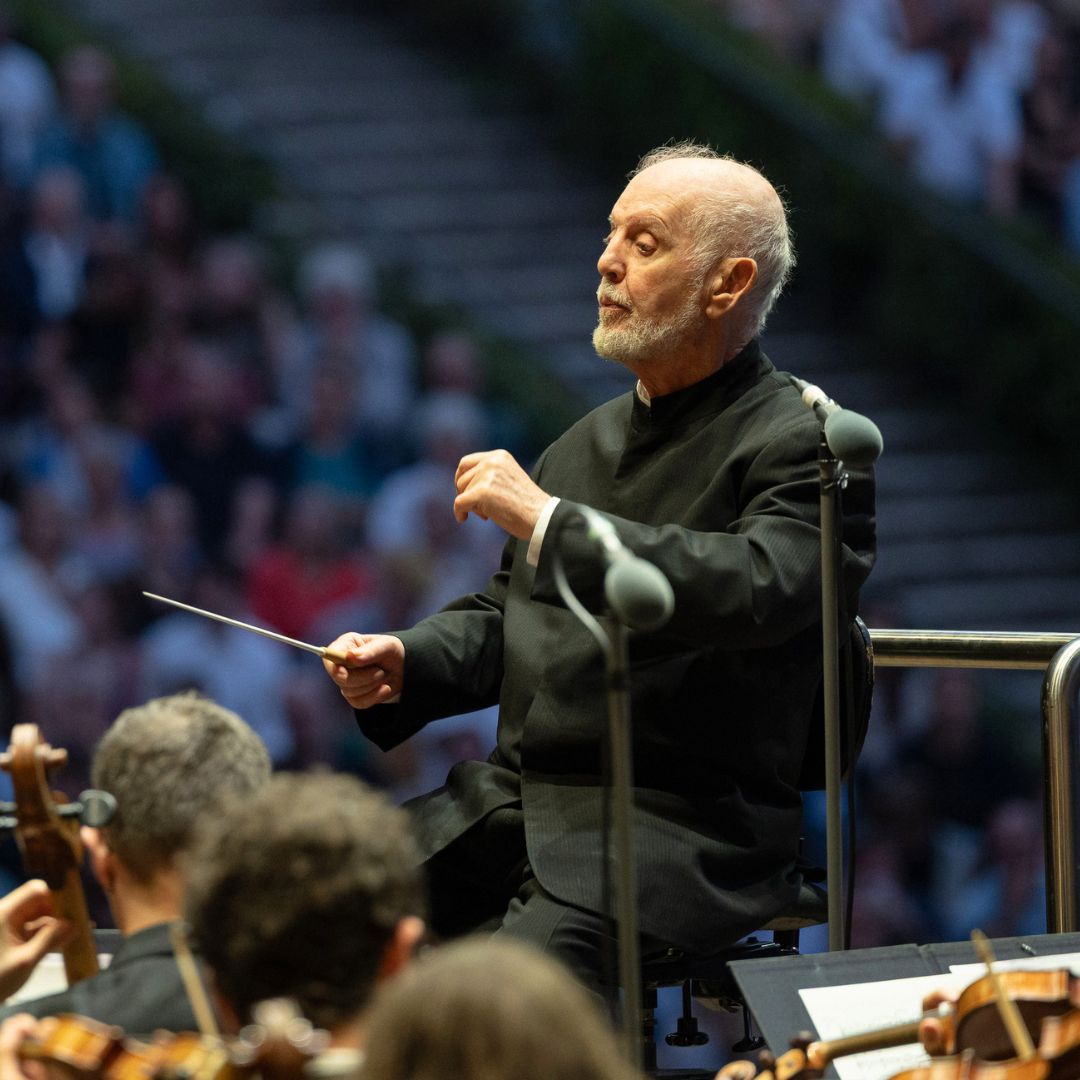
Daniel Barenboim
Conductor
Daniel Barenboim was born in 1942 in Buenos Aires, where he gave his first public concert at the age of seven. He moved to Israel with his parents in 1952. At the age of 11, he participated in Igor Markevitch’s conducting classes in Salzburg, before going on to study harmony and composition with Nadia Boulanger in Paris. As a pianist and conductor, he has performed with virtually all major artists around the world. Chief conductor of the Orchestre de Paris from 1975 to 1989, he subsequently served as music director of the Chicago Symphony Orchestra from 1991 to 2006 and held leading positions at Milan’s Teatro alla Scala between 2007 and 2014. He also regularly appeared at the Bayreuth Festival for almost two decades. From 1992 to 2023, he led Berlin’s Staatsoper Unter den Linden as general music director; the Staatskapelle Berlin appointed him chief conductor for life in 2000. In 1999, Daniel Barenboim and Palestinian literary scholar Edward W. Said founded the West-Eastern Divan Orchestra, which brings together young musicians from Israel, Palestine, and other countries of the Middle East and Northern Africa with the goal of opening a dialogue between the different cultures of the region through the shared experience of music-making. The project led to the creation of the Barenboim-Said Akademie in Berlin, which began teaching activities in 2015. The Pierre Boulez Saal opened in the same building in 2017. Daniel Barenboim was awarded the Great Cross of Merit of the Federal Republic of Germany. He is a Knight Commander of the British Empire as well as a Commandeur de la Légion d’Honneur and holds an honorary doctorate from the University of Oxford. In 2007, UN Secretary General Ban Ki-moon named him a UN Messenger of Peace.
November 2026
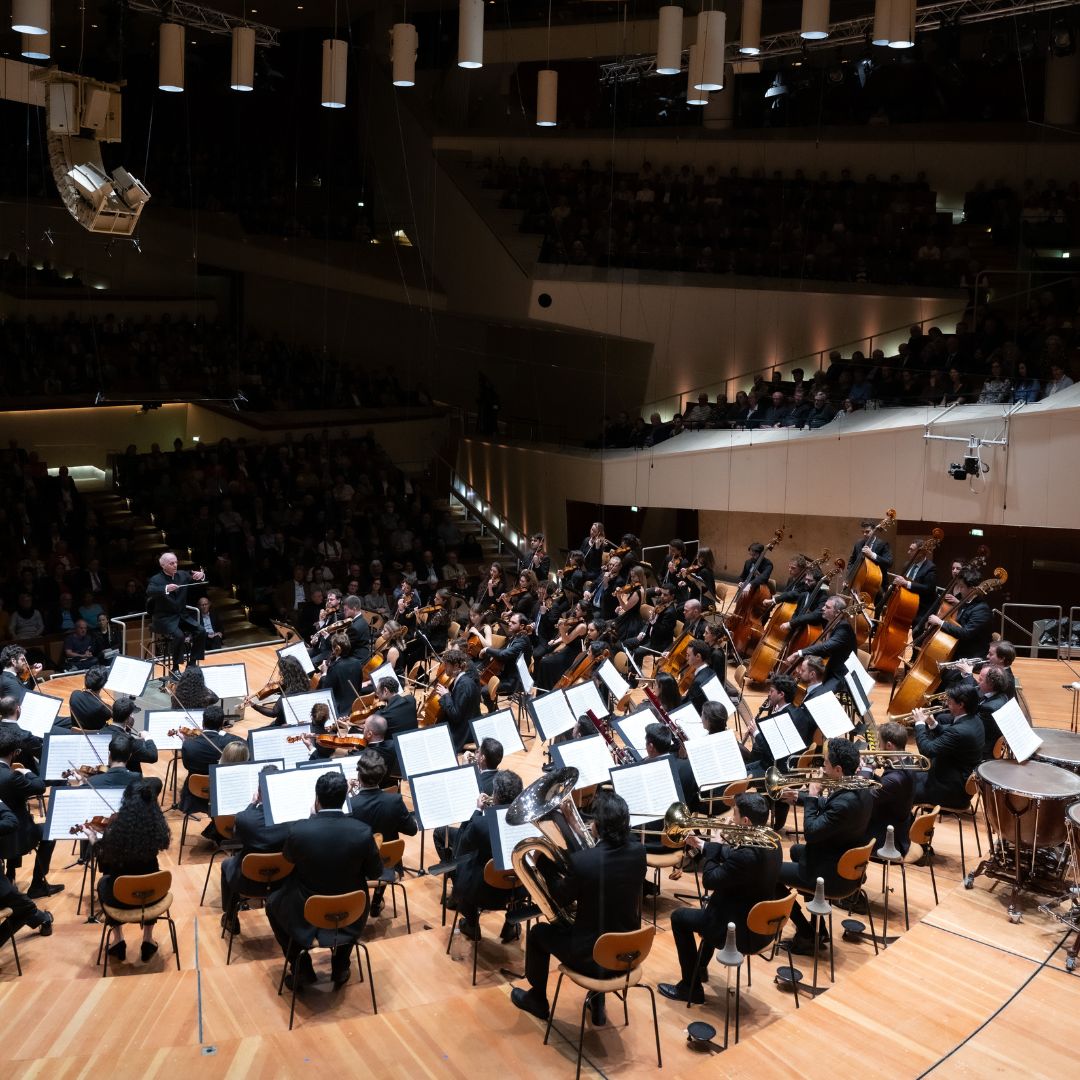
West-Eastern Divan Orchestra
For more than a quarter of a century, the West-Eastern Divan Orchestra has been a significant presence on the international music scene. In 1999, Daniel Barenboim and Palestinian literary scholar Edward W. Said created an orchestra for young musicians to promote dialogue between the different cultures of the Middle East through music-making and co-existence. They named the project after Johann Wolfgang von Goethe’s collection of poetry West-Eastern Divan, a central work for the development of the concept of world culture. The majority of the orchestra’s members hail from Israel, Palestine, Iran, Türkiye, Egypt, Lebanon, and other countries of the region. They meet several times a year for workshops, where rehearsals are complemented by lectures and discussions, followed by international concert tours. The orchestra has performed at the world’s most prestigious festivals and concert halls such as the Salzburg and Lucerne festivals, the BBC Proms, the Schleswig- Holstein Musik Festival, Carnegie Hall, Hamburg’s Elbphilharmonie, and Teatro Colón in Buenos Aires. Beyond this, it remains one of the orchestra’s most important goals to perform in the members' home countries. Appearances in Rabat, Doha, and Abu Dhabi and the landmark concert in Ramallah in 2005 have been important steps toward fulfilling this aspiration. The only political aspect that prevails in the work of the West-Eastern Divan Orchestra is the conviction that there is no military solution to the Middle East conflict and that the destinies of Israelis and Palestinians are inextricably linked. Based on the notion of equality, co-operation, and justice for all, the orchestra represents an alternative model to the situation in the Middle East, proving time and again that music can built bridges and break down barriers previously considered insurmountable. In honor of this mission, UN Secretary-General Ban Ki-moon in 2016 named the West-Eastern Divan Orchestra a UN Global Advocate for Cultural Understanding.
November 2026